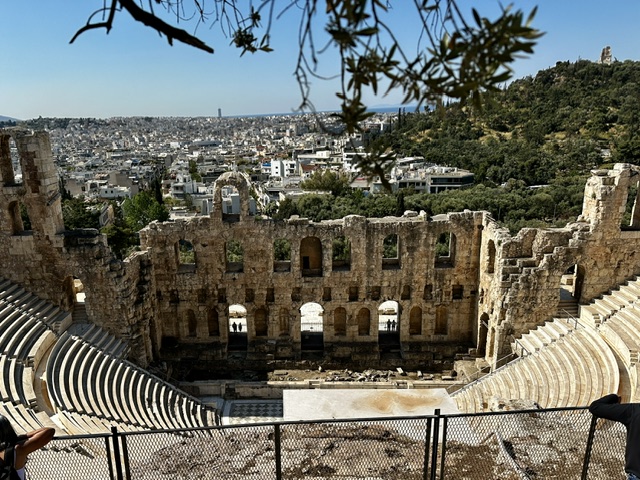
Athens 3-4 May
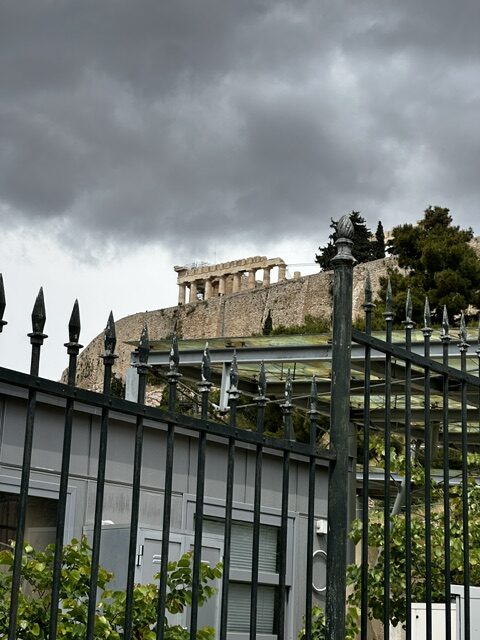
Athens is truly one of the world’s most important historical cities. Everywhere we looked, we saw evidence of the civilizations that came before. Of course, we walked the Acropolis to see the Parthenon, the massive temple to Athena who Athens was named for. The entire site was religious in nature and included other structures – the Propylaea, Erechtheion, and the Temple of Nike. The Parthenon is undergoing a major renovation but is still magnificent.
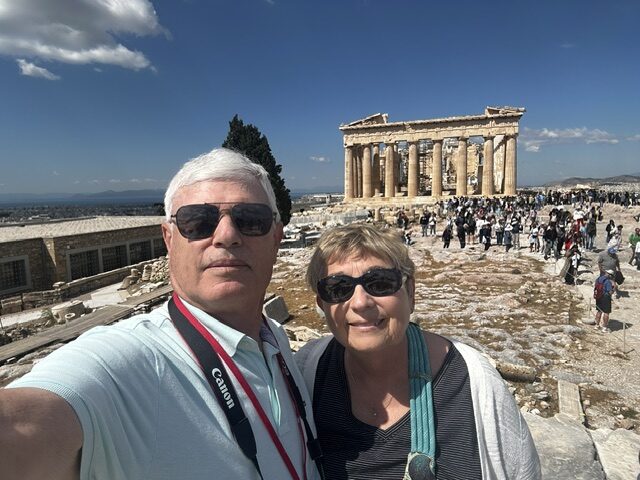
As we ascended the hill to the Acropolis we could see the nearby Agora, the site of Athenian democracy where the people (well okay, just free men) gathered to consider the issues of their time and conduct business. There was a stark contrast between the masses of tourists visiting the Acropolis and the meager few visiting the Agora. Yet to me, that site is of greater significance to the democracies of the Western world, including our own.
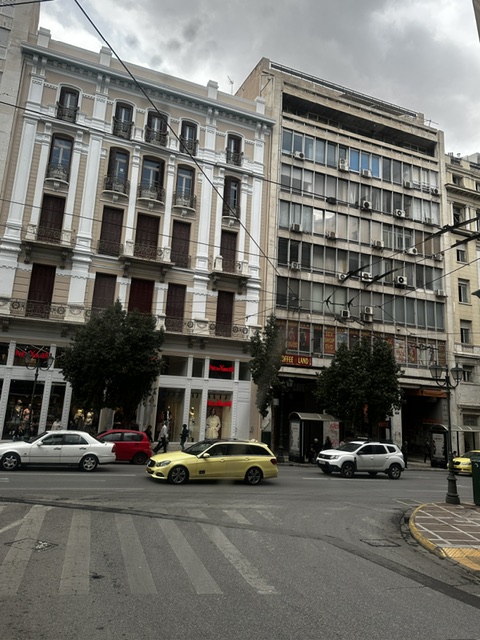
Architecturally, modern Athens is a rather unlovely city. After WW II there was a major influx of population from Greece’s rural areas into the cities, resulting in a serious housing shortage. The city started erecting apartment buildings to house the masses of new residents, and appearance took a back seat to expedience. And the ubiquitous graffiti doesn’t help. There are certainly beautiful buildings here, but they are not always easy to spot amongst the preponderance of drab, boxy, structures. Pictured below is an attractive neoclassical building attached to one of the ugly ducklings with its exposed air conditioning units.
Here’s some food for thought. When Christianity was in its infancy, while the official language of the Roman Empire was Latin, the language spoken by most people for trade and commerce was Greek. For that reason, the disciples of Christ were able to spread the Gospel, in Greek, throughout the Middle East, the Levant, Greece, and even Rome. What might the world look like had that not been the case?